Wednesday, March 27, 2013
Time Travel Self Evaluation
I would say there were points I planned out prior to my presentation that I would have liked to stick closer to or execute more confidently, particularly with regards to the bit where I almost said Benjamin Franklin "invented" electricity. I also fidgeted and rocked nervously throughout the process, which is a habit of mine I can hopefully iron out via practice before I present the Capstone.

Monday, March 25, 2013
Capstone: Music and Story
When writing a plot, there are two things you need to strive for. Well not really, but for the purposes of this project, let's stick with two right now. The first is a plot that is coherent; the second is a plot that is emotionally investing. The latter is where it can be easier for a creator to make his work into a film or play. In a story, musical cues can greatly amplify (or detract from) the way your audiences are immersed in your work. There's a lot of skill involved in doing it right, and those who have that skill become legends in the industry. Their reputations (and their discographies) speak for themselves; Zimmer, Williams, Hitchcock and Herrmann, etc. But before we can talk about the work they did, we have to go back in time. Really, really far back in time.
The Greeks believed that music brought you closer to the Gods. Especially reverent an instrument back then was the lyre. Invented by the god Apollo, the lyre is a small harp-like string instrument fashioned from a turtle's shell. Traveling poets would carry their lyres, and little else, and play while they recited their poetry. One such poet was Homer, the ancient poet who was, of course, responsible for the Iliad and Odyssey. The lyre became one of the first in a long line of folk instruments, instruments that have significance in the culture of their inventor. The Indigenous Americans have animal-skin drums. The Indians use traditional string instruments like the sitar. Australian Aborigines play the didgeridoo.
The music of Homer's lyre added a layer to the immersion of his stories. We see this behavior today in TV shows. The next time you watch a nighttime drama, or perhaps your daytime soaps, listen for the background music. You probably don't notice it half the time you're watching, but still it plays.
Shakespeare said, "If music be the food of love, play on." By his time, storytelling had long graduated from wandering Greek poets to semi-permanent Greek amphitheaters. The musical play had not yet been invented yet, but music still played (no pun intended) a meaningful role. Sophocles' Oedipus Cycle had a Choral interlude after every scene, in which the chorus would sing a three-part ode. As they crossed the stage, they would recite a strophe, followed by an antistrophe as they crossed back. Then they would finish in an epode in a different meter than the two strophies.
Music never left the stage either. According to Encyclopedia Britannica, "It was customary n Tudor and Stuart Drama to include at least one song in every play." While left out of most textual reprints, Shakespeare's Macbeth contained songs during the witches' scenes, though no actual notation of the scoring remains. Somewhat superstitious, the citizens of Olde-Timey England gravitated to sounds that were clean and easy to listen to. Lutes were considered to be good, soulful instruments to hear in the Elizabethan age. Oboes, on the other hand, played "ill winds that blew no good," and were used for dark or unsettling scenes.
Today we have many instruments at our disposal, and the way they resonate with us emotionally in part comes down from the traditions of Shakespeare's time. Oboes, along with other low wind instruments like the bassoon and the clarinet's lower register still evoke somber, unsettling thoughts. Though contextually no more or less scary than the rest of the ballet about moving dolls and child-abducting rats, the "Arabian Dance" from Tchaikovsky's Nutcracker is one of the more creepy character dances. On the other hand, the piccolo in "Chinese Dance" gives it a decidedly more uplifting feel. Have a listen:
The tempo and key of the song helps to add that certain je ne sais quoi. I'll spare you the music theory lesson, but "Arabian Dance" is in a minor key, while "Chinese Dance" is in a major key. Minor keys are known to be more sad-sounding than major ones. Additionally, the Arabian Dance has a markedly slower pace.
In the 1980's, directors of "action movies" have dipped into the classical pool of music for their trailers, namely the 1936 Carmina Burana by Carl Orff. Chances are you've never heard it performed as an actual cantata, but in the trailer for a big budget movie. Feel free to stop the clip after you get the idea.
It's worth mentioning that that's Mozart, not Orff, pictured in the thumbnail.
Other than the fact that it's public domain and therefore highly cost-effective, there are a few reasons why "O' Fortuna" shows up so often to pump up its audience. It doesn't impact the story per se, but it does get people invested in hearing the story. At some point after the Romans died away, someone decided that Latin is a really dramatic, ominous language when belted out by a choir. The unfamiliar, ancient chanting has, after iteration after iteration in film, developed the ability to immediately pump the adrenaline and seemingly raise the stakes of the onscreen footage. And when the bombast of Burana is too much, baritones and trombones can up the adventurousness too. Stay tuned for that.
Winds and brass have very distinct sounds and varying skill sets. But for the widest range of emotion, the king of the heap is the violin. Alone they can express moving sorrow, or rousing festivity. In groups, they can carry any number of styles. One duo put violins to quite good use...
It's not often that a director is as in tune with the music of his film as its composer, but Alfred Hitchcock certainly fills that role. His relationship with composer Bernard Herrmann was one of the strongest in Hollywood, and together they built an empire founded on the basic human feeling of suspense. Hitchcock movies like North by North-West and Vertigo popularized the whirring strings that you hear so often today in shows like Lost.
It just grates on you, doesn't it? The sawing back in forth of the strings just makes you want something to happen that will make it stop. Herrmann and Hitchcock also started the trend of "scare chords" when they made a little movie called Psycho.
The harsh, piercing shrieks of the violins illustrate a picture Hitchcock couldn't show in his era of filming, speaking volumes for the violence unfolding just off-camera. The sound has yeilded countless followers and parodies over the generations. Especially for creating "jump-scares." Actually, half the reason jump-scares work is because of the scare chord. If the sudden visual doesn't alarm you, the loud noise probably will.
Hitchcock also knew how to when to use silence to his advantage. There's a scene from The Birds in which a woman finds a man murdered (by the birds naturally) free of all music, leaving us nothing to focus on but her strained gasps as she tries to find the air to scream.
In today's Hollywood, no composer is more prolific than John Williams (Superman, the Star Wars trilogies, most of Steven Spielberg's repertoire, the first three Harry Potters, etc.) Williams has a knack for giving characters their own tunes to blend into the background music. Chances are you've heard the Imperial March from the first Star Wars trilogy, the theme music for Darth Vader, the film's helmeted antagonist. Fast forward now to the prequel trilogy, telling Vader's story from humble beginnings as the boy Anakin Sywalker, and you'll get a taste for Williams's skill as a composer. This is "Anakin's Theme."
Listen at the end of each phrase, and you'll hear the sweeping score transition into the tail end of the Imperial March. For reference I'd let you hear the real deal, but that would be against copyright law - and that would be terrible. Regardless, the result is an interesting Easter-egg that carries meaningful plot-significance.
The emotional output of a piece depends greatly on its instrumentation and tempo. The Harry Potter series has used "Hedwig's Theme" as a theme song since its innaugural outing in 2001. The Sorceror's Stone introduced the theme with a mysterious and whimsical air, befitting of the child-friendly atmosphere the film possessed.
The sixth film, The Half-Blood Prince, is an escalation point in the conflict with Voldemort. The theme is still recognizable, but the tempo is slightly faster, and there's a heavy focus on baritone horns. The result is a more urgent and adventurous score.
The eighth and last film, the second part of The Deathly Hallows, takes pains to demonstrate the finality of the series. Hedwig's theme reverts back to its music-box-like sound, only tiny, distant, broken.
Music's influence on story doesn't have anything to do with the way we actually understand the story; rather, it affects the emotional connection we make to the story. If we cry, it makes us sob, if we chuckle, it makes us roar with laughter. Whether or not music is the food of love, audiences eat it up, and that's not about to change anytime soon.
Citations: https://docs.google.com/viewer?a=v&pid=gmail&attid=0.1&thid=13df5771f814e91d&mt=application/vnd.openxmlformats-officedocument.wordprocessingml.document&url=https://mail.google.com/mail/ca/?ui%3D2%26ik%3D6481424de1%26view%3Datt%26th%3D13df5771f814e91d%26attid%3D0.1%26disp%3Dsafe%26realattid%3Df_hfcwl73n0%26zw&sig=AHIEtbT-BFKDxyC3Lu_pbDEmtUu6jA4haA
The sixth film, The Half-Blood Prince, is an escalation point in the conflict with Voldemort. The theme is still recognizable, but the tempo is slightly faster, and there's a heavy focus on baritone horns. The result is a more urgent and adventurous score.
The eighth and last film, the second part of The Deathly Hallows, takes pains to demonstrate the finality of the series. Hedwig's theme reverts back to its music-box-like sound, only tiny, distant, broken.
Music can do, as Hans Zimmer (Inception, The Dark Knight, Pirates of the Caribbean) puts it, "unseen things" to the stories of movies and plays. It can immerse the audience further when done right, but when done wrong it can really take you out of the experience. One British studio actually had to lower the background music of its Planet Earth-like science documentary Wonders of the Universe after too many complaints that viewers couldn't hear the host over the background music.
The other pitfall is that old adage "you can't please 'em all." Sometimes the music in a work, or the actor portraying a role, makes the viewer turn up their nose to the point that they can't focus on the story your telling. The author of the report on Wonders of the Universe, for example, can't stand the upright base in the score to Seinfeld.Music's influence on story doesn't have anything to do with the way we actually understand the story; rather, it affects the emotional connection we make to the story. If we cry, it makes us sob, if we chuckle, it makes us roar with laughter. Whether or not music is the food of love, audiences eat it up, and that's not about to change anytime soon.
Citations: https://docs.google.com/viewer?a=v&pid=gmail&attid=0.1&thid=13df5771f814e91d&mt=application/vnd.openxmlformats-officedocument.wordprocessingml.document&url=https://mail.google.com/mail/ca/?ui%3D2%26ik%3D6481424de1%26view%3Datt%26th%3D13df5771f814e91d%26attid%3D0.1%26disp%3Dsafe%26realattid%3Df_hfcwl73n0%26zw&sig=AHIEtbT-BFKDxyC3Lu_pbDEmtUu6jA4haA
Sunday, February 24, 2013
Oscars Wild
Named for the first six-inch tall gold person to act in Hollywood, the Oscars are the most prestigious event of the year recognizing outstanding films and film-makers. But what makes a movie worthy of the Academy's attention?
For one thing, it isn't the box-office. While usually a decent way to get a nomination, huge revenue does not an Oscar get. 2012's biggest movie, the Avengers, only netted a single nomination (for Visual Effects). Popularity isn't a guarantee either; I'd even say it's a stymie. Some of the big titles press-wise, Avengers, The Dark Knight Rises, and The Hobbit: An Unexpected Journey received 1, 0, and 3, respective nominations.
The Academy of Motion Pictures seems to favor what we might call "artsy-fartsy" films. Last year's The Artist and 2010's The King's Speech were far from the most popular movie of their respective years. The idea is to look for great, well-made films, not blockbuster ones. Thus the cinematography (and acting, art direction, etc.) won the not at all sophisticated Return of the King Best Picture and 10 other Oscars in 2003.
I was surprised that, after The Dark Knight's Best Picture snub-fiasco in 2009, Rises received no love, even pity-love, from the Academy. Personally, I'm pulling for Lincoln to sweep the upper tier of awards (Daniel Day-Lewis is at least a shoe-in for Lead Actor). However, artsier films like Les Miserables and Life of Pi are serious contenders to spoil Spielberg's night.
Thursday, February 21, 2013
Two Degrees of Adam Sandler
Mr. Carty considered Will Ferrel's role in Stranger Than Fiction as the "straight man". This blog post has nothing to do with Will Ferrel.
The straight man is, by association, the most normal character in his inner circle, if not the plot entirely. Think about the people Harold works with. Think about Dave. Think about Harold's reaction to Dave and his surroundings. That's kind of the way I prefer Ferrel and his ilk. To compare and contrast, I reccomend you watch Jack and Jill.
While not the pinnacle of Sandler's resume, this movie is an excellent case study in two types of comedy. Jill represents everything I hate about Sandler comedy; she's childish, obnoxious, and about as subtle as a neon-green elephant with cymbals on its feet. Jack is everything I enjoy about Sandler comedy; he's just kinda walking down the street, sees a hobo with a banana, and he's just like, "Huh. That sure is a hobo." Then he moves onto the next scene. He's so good at straight-man comedy that you wonder why he spends so much screen-time flapping his arms and making inane faces at the camera.
Monday, February 18, 2013
Grammar? What am you talking about?
Earlier this week we got a handout about the liberties an author is allowed to take with grammar to make their works better. This is largely because normal people don't talk using the grammatical conventions we learn in school. This is especially true for people who write in colloquialisms form way back when, or who use modern informal speech. Further room for experimentation comes into play when a writer experiments with funny accents.
And then there's sentence fragments, a major grammatical faux-pas. For example, when you are asked, "Why aren't you eating?", grammar dictates that the proper response is "I am not eating because I am not hungry."
HOWEVER!
Who actually says things like that? Most people would say something like, "Eh, not really hungry." or, like me, "No reason." That's like sacrilege or something. And while we're on that, like, subject; there's stuttering and catching. This isn't particularly common in the written word unless they have a lithp or other s-s-s-speech impediment. In normal speech, people aren't practiced orators, so they can repeat themselves or other... stuff.
And then there's sentence fragments, a major grammatical faux-pas. For example, when you are asked, "Why aren't you eating?", grammar dictates that the proper response is "I am not eating because I am not hungry."
HOWEVER!
Who actually says things like that? Most people would say something like, "Eh, not really hungry." or, like me, "No reason." That's like sacrilege or something. And while we're on that, like, subject; there's stuttering and catching. This isn't particularly common in the written word unless they have a lithp or other s-s-s-speech impediment. In normal speech, people aren't practiced orators, so they can repeat themselves or other... stuff.
Wednesday, February 6, 2013
Point of View in Crime and Punishment
Crime and Punishment is most obviously told from the 3rd Person Limited. We follow the sociopathic protagonist Raskolnikov around London, and stay firmly rooted in his life, right. Wrong! The esteemed Mr. Dostoevsky actually creates an ingenious hybrid of Third Person views. We actually follow Raskolnikov around in a sort of narrative bubble of Omniscience. So while we focus on Rodyon for the majority, we can follow the people that he just interacted with for a block or so. We can also peer into the minds of the other characters, though this is used very sparingly by the author. We see the latter technique when Rodya meets Marmeladov in the bar. Dostoevsky gives us some juxtaposition between Ol' Marm's outgoing personality and inner turmoil. The former we see when Pulcheria and Dunya leave Rodyon's house. Rodya would have no means of hearing this conversation, but we do, and will likely need to remember it for later.
Tuesday, January 29, 2013
Out West
This is the blog post for the week of January 28. The blog post for last week precedes this one, and is dated thus.
This weekend, as I pondered through a second viewing of Industrial Light and Magic's Rango, I realized just how much this outwardly so-so picture manages to lovingly homage its western roots.
A Western takes place between the end of the Civil War and the 1890's, when the frontier closed. Westerns actually originated in literature well before the War, when the "frontier" was east of the Missouri River. One of the earliest films in the genre (or of any genre for that matter), was The Great Train Robbery of 1903. Train Robberies are a staple of the Western Genre (and one of the only elements Rango doesn't homage or parody). During the 50's and 60's Western TV Shows and Comics exploded, and from Bonanza to Gunsmoke to Jonah Hex they still remain in semi-public conscience. It was a time of bank robbers and wanted posters, cattle drives and posses. Gunslingers faced off at high noon, and unsavory characters walked bow-legged into saloons.
But when you think of a Western (even though few do anymore) you probably think of the genre's little amigo, the Spaghetti Western. Called so because of their Italian studio origin, Spaghetti Westerns were often filmed on location in Spain (Where the cacti were more stereotypical). They were often distillations and deconstructions (breakdowns) of regular Westerns, but managed to outshine their inspirations. Sergio Leone directed the Dollars Trilogy (A Fistful of Dollars, For a Few Dollars More, and The Good, the Bad, and the Ugly), source of some of Wild West cinema's most seminal scenes (like that song that always plays when a gunfight happens), and helped make Clint Eastwood (The Man With No Name) the household name he is today.
This weekend, as I pondered through a second viewing of Industrial Light and Magic's Rango, I realized just how much this outwardly so-so picture manages to lovingly homage its western roots.
A Western takes place between the end of the Civil War and the 1890's, when the frontier closed. Westerns actually originated in literature well before the War, when the "frontier" was east of the Missouri River. One of the earliest films in the genre (or of any genre for that matter), was The Great Train Robbery of 1903. Train Robberies are a staple of the Western Genre (and one of the only elements Rango doesn't homage or parody). During the 50's and 60's Western TV Shows and Comics exploded, and from Bonanza to Gunsmoke to Jonah Hex they still remain in semi-public conscience. It was a time of bank robbers and wanted posters, cattle drives and posses. Gunslingers faced off at high noon, and unsavory characters walked bow-legged into saloons.
But when you think of a Western (even though few do anymore) you probably think of the genre's little amigo, the Spaghetti Western. Called so because of their Italian studio origin, Spaghetti Westerns were often filmed on location in Spain (Where the cacti were more stereotypical). They were often distillations and deconstructions (breakdowns) of regular Westerns, but managed to outshine their inspirations. Sergio Leone directed the Dollars Trilogy (A Fistful of Dollars, For a Few Dollars More, and The Good, the Bad, and the Ugly), source of some of Wild West cinema's most seminal scenes (like that song that always plays when a gunfight happens), and helped make Clint Eastwood (The Man With No Name) the household name he is today.
Sunday, January 27, 2013
Noir
This is the blog for the week of January 21.
So, before we started reading Crime and Punishment, I mistook it for a member of the Film Noir genre. Popularized in the 40's, noir is the typical "crime drama" style, before crime dramas inundated the prime-time TV scene. Noir typically featured your private gumshoe, your street hustler with a heart of gold, and other hard-boiled smooth-talker types. The words "dame" and "doll" are thrown around a lot.
In visual media, Noir is striking based on its light and dark contrasts. Shadows are long and often partially obtrusive to faces (known as chiaroscuro), and light will be used sparingly, often for dramatic effect (horizontal blinds are a staple). Dutch angles and other atmospheric positions are fair game. Authentic noir is shot in black and white of course, given the era.
Cynical, fast-talking, and never far from his cigarette, the protagonist will often be less then wholesome, but never genuinely evil. His outlook on the city he lives in (and it's always a city) is, as a rule, bleak and defeatist, often disillusioned by an event from his past.
Venerated printed examples include The Maltese Falcon and The Postman Always Rings Twice. Those two books were adapted into movies, the latter of which starred Humphrey Bogart, famous for Casablanca, another Noir Film.
So, before we started reading Crime and Punishment, I mistook it for a member of the Film Noir genre. Popularized in the 40's, noir is the typical "crime drama" style, before crime dramas inundated the prime-time TV scene. Noir typically featured your private gumshoe, your street hustler with a heart of gold, and other hard-boiled smooth-talker types. The words "dame" and "doll" are thrown around a lot.
In visual media, Noir is striking based on its light and dark contrasts. Shadows are long and often partially obtrusive to faces (known as chiaroscuro), and light will be used sparingly, often for dramatic effect (horizontal blinds are a staple). Dutch angles and other atmospheric positions are fair game. Authentic noir is shot in black and white of course, given the era.
Cynical, fast-talking, and never far from his cigarette, the protagonist will often be less then wholesome, but never genuinely evil. His outlook on the city he lives in (and it's always a city) is, as a rule, bleak and defeatist, often disillusioned by an event from his past.
Venerated printed examples include The Maltese Falcon and The Postman Always Rings Twice. Those two books were adapted into movies, the latter of which starred Humphrey Bogart, famous for Casablanca, another Noir Film.
Monday, January 21, 2013
You Read a Post About the Second Person...
Before I begin, let me follow up on last week by breifly discussing Huck Finn. Twain writes in a pseudo-present tense, as while it's clear that Huck is speaking about previous events, he uses phrasing like "He says," or "I am." It's supposed to be like listening to someone tell a story, or like one of those "A guy walks into a bar" jokes. I hadn't considered this kind of implement of present tense last week; it gets my approval.
Now, today we discuss an even more narrowly implemented style: second person. To put it concretely, The second person is a story in which you are a participant, and which is told from your perspective by a limited narrator. This technique is almost exclusively relegated to the text based or "Chose your own" media. Interactivity is almost a necessity, as dictating a reader's actions to them is essentially a less efficient form of third person limited.
Now, today we discuss an even more narrowly implemented style: second person. To put it concretely, The second person is a story in which you are a participant, and which is told from your perspective by a limited narrator. This technique is almost exclusively relegated to the text based or "Chose your own" media. Interactivity is almost a necessity, as dictating a reader's actions to them is essentially a less efficient form of third person limited.
Tuesday, January 8, 2013
Brian writes about writing in the present tense
This month I am writing about some of the less commonly utilized narrative mode. This week; my least favorite method: Present Tense. I am trying to remember one book I once read that was written entirely in this tense. Basically, the writer plans his narrative, then writes the characters as though they were currently acting them. One tends to get odd, unnatural feeling sentences like "John plans the surprise party," or '"Hey, stop that!" Jane cries.' This is a rarely used tactic, as it doesn't offer as much flexibility in story telling.
**Editor's Note: An adendum to this post has been written into next weeks post.
**Editor's Note: An adendum to this post has been written into next weeks post.
Tuesday, December 18, 2012
Super Sugarplum Pre-Apocalyptic Holiday Mega Crunchy Post!
Merry holiday-times everyone!
Chances are, you've heard we've yet another end of the world on our hands. Just in case something does happen later, let's talk about writers' fixation on the apocalypse - now!
It's fairly common for sci-fi writers to mention the end of the world; either as a setting for the tale or a potential stake if the hero loses. The apocalypse offers a great deal of freedom for an author to craft (or un-craft) his world. It also goes along way towards sparking public interest in how our little blue marble may one day meet its maker. In recent year it's been all about the zombies; zombies with guns, zombie plagues, fat zombies, short zombies, zombies that climb on rocks, the list goes on. No one is sure how the cultural movement began (though the word has roots in voodoo and Night of the Living Dead seems to be their first successful mainstream outing), but the walkers are now inundating mass media, from Call of Duty games to The Walking Dead comics to The View.
Going further back we see definitive streaks of alien invasions/annihilations. Meteor strikes and other natural phenomena are safe bets too in the right setting (Roland Emerich's made a career of it, with Independence Day and Day After Tomorrow, among others).
The 2012 Mayan Apocalypse has sparked its own number of responses, from the big budget (2012) to Walmart bin Schlock I can't even remember. This past weekend I saw 4 different trailers for end-of-the-world movies, including the deftly titled After Earth (by the incomparable M. Knight Shaymalan), a romantic comedy with - you guessed it- zombies, and the requisite "Giant Robots fight Giant Monsters" flick.
The point is, even when we aren't supposed to die later in the week, pop culture has a fascination with the End. Have we exhausted all possible scenarios? Will we ever have a new fate to fear? WE may never know.
5
Now that that's out of the way...
If you are reading this, it means the world may not have ended yet, which means it's time for the Super Secret Holiday Message! In every blog post I've made thus far (starting with #2) I have left a fragment to a coded message of the utmost yuletide importance. Can you decode it? Here's a hint:
Chances are, you've heard we've yet another end of the world on our hands. Just in case something does happen later, let's talk about writers' fixation on the apocalypse - now!
It's fairly common for sci-fi writers to mention the end of the world; either as a setting for the tale or a potential stake if the hero loses. The apocalypse offers a great deal of freedom for an author to craft (or un-craft) his world. It also goes along way towards sparking public interest in how our little blue marble may one day meet its maker. In recent year it's been all about the zombies; zombies with guns, zombie plagues, fat zombies, short zombies, zombies that climb on rocks, the list goes on. No one is sure how the cultural movement began (though the word has roots in voodoo and Night of the Living Dead seems to be their first successful mainstream outing), but the walkers are now inundating mass media, from Call of Duty games to The Walking Dead comics to The View.
Going further back we see definitive streaks of alien invasions/annihilations. Meteor strikes and other natural phenomena are safe bets too in the right setting (Roland Emerich's made a career of it, with Independence Day and Day After Tomorrow, among others).
The 2012 Mayan Apocalypse has sparked its own number of responses, from the big budget (2012) to Walmart bin Schlock I can't even remember. This past weekend I saw 4 different trailers for end-of-the-world movies, including the deftly titled After Earth (by the incomparable M. Knight Shaymalan), a romantic comedy with - you guessed it- zombies, and the requisite "Giant Robots fight Giant Monsters" flick.
The point is, even when we aren't supposed to die later in the week, pop culture has a fascination with the End. Have we exhausted all possible scenarios? Will we ever have a new fate to fear? WE may never know.
5
Now that that's out of the way...
If you are reading this, it means the world may not have ended yet, which means it's time for the Super Secret Holiday Message! In every blog post I've made thus far (starting with #2) I have left a fragment to a coded message of the utmost yuletide importance. Can you decode it? Here's a hint:
9=I
20=T
Good Luck, Happy Holidays, and listen to the Little Orphan Annie radio show!
Sunday, December 9, 2012
The Lost Sequel to the Odyssey
The Iliad and Odyssey are some of Homer's most famous works, detailing the Trojan War. But according to a scholar named Proclus, they are but two in a series of eight epic poems. None were written by Homer, but when stitched together they fill in his missing pieces of the war.
Now, we don't actually have any way of proving Proclus' story, but other writers have quoted the six alledged tales, and tiny scraps of them have survived in paper. Asside from that, it's difficult to question him. We know the Trojan War happened, so it's logical that someone wrote about it, and we know it was common to write epic poetry back then. If the only existing evidence of Julius Caesar was that some dude from the Elizabethian Period claimed there was a drama about the assassination of Caesar, could we refute it? We know that the assasination did take place, and we know that there were many famous playwrites in Elizabethian England - including Shakepeare. 14
The last book in the lost collection, the Telegony, details the end of Odysseus' life. According to Proclus, Odysseus returns home to Ithaca from his latest adventure (which sees him marry the queen of a faraway land and remain there long enough to see his illegitimate child reach adulthood) just in time for the invasion of Telegonus, the bastard child of Odysseus and - gasp! Circe! It seems Telegonus went to visit his long-lost father, but didn't appreciate his absence when he got there.
Now, we don't actually have any way of proving Proclus' story, but other writers have quoted the six alledged tales, and tiny scraps of them have survived in paper. Asside from that, it's difficult to question him. We know the Trojan War happened, so it's logical that someone wrote about it, and we know it was common to write epic poetry back then. If the only existing evidence of Julius Caesar was that some dude from the Elizabethian Period claimed there was a drama about the assassination of Caesar, could we refute it? We know that the assasination did take place, and we know that there were many famous playwrites in Elizabethian England - including Shakepeare. 14
The last book in the lost collection, the Telegony, details the end of Odysseus' life. According to Proclus, Odysseus returns home to Ithaca from his latest adventure (which sees him marry the queen of a faraway land and remain there long enough to see his illegitimate child reach adulthood) just in time for the invasion of Telegonus, the bastard child of Odysseus and - gasp! Circe! It seems Telegonus went to visit his long-lost father, but didn't appreciate his absence when he got there.
Thursday, December 6, 2012
The Death of Ophelia
9
When King Hamlet died, it made his son vengeful and crazed. The same thing happened when Hamlet slew (slayed?) Polonius, only Polonius had two kids. Laertes got the vengeful, and Ophelia got the crazed.
Only whereas Hamlet could have been faking his insanity, Ophelia definitely isn't faking hers.
It may seem odd for someone to be so stricken with grief that they develop an unaimed loss of composure, but for Ophelia, it's a blade that cuts on both ends. Obviously on one hand comes the sudden death of her father, but on the other hand comes the man responsible; Hamlet. The man she loves just killed her father, and she doesn't know how to cope with this.
So we come to one of the most famous scenes in Hamlet that you've never seen. After an outburst of creepy singing in the courtyard, Ophelia drowns hanging Laurels by the river. But what exactly happened? Shakepeare leaves it ambiguous, but there are a few options. She could have simply slipped, or she could have committed suicide. Her mental condition muddles the water even further. Perhaps she even went for a swim, not realizing in her state that she was wearing a flowing, heavy dress. Each option is equally likely, which was probably Will's intention.
When King Hamlet died, it made his son vengeful and crazed. The same thing happened when Hamlet slew (slayed?) Polonius, only Polonius had two kids. Laertes got the vengeful, and Ophelia got the crazed.
Only whereas Hamlet could have been faking his insanity, Ophelia definitely isn't faking hers.
It may seem odd for someone to be so stricken with grief that they develop an unaimed loss of composure, but for Ophelia, it's a blade that cuts on both ends. Obviously on one hand comes the sudden death of her father, but on the other hand comes the man responsible; Hamlet. The man she loves just killed her father, and she doesn't know how to cope with this.
So we come to one of the most famous scenes in Hamlet that you've never seen. After an outburst of creepy singing in the courtyard, Ophelia drowns hanging Laurels by the river. But what exactly happened? Shakepeare leaves it ambiguous, but there are a few options. She could have simply slipped, or she could have committed suicide. Her mental condition muddles the water even further. Perhaps she even went for a swim, not realizing in her state that she was wearing a flowing, heavy dress. Each option is equally likely, which was probably Will's intention.
Tuesday, November 27, 2012
What the Devil?
We already know from our time in the Inferno that Dante established a vision of Hell that holds true to this day. We also know that many of his interpretations have not held up as well, cheifly being the diminishing of Satan.
We often see Satan as a malicious force of temptation and evil, with red skin, horns, a goatee, and impeccable skills on the fiddle. Despite Dante's rather ingenious way of showing how internally weak the Devil is, he's always coniving in popular culture.
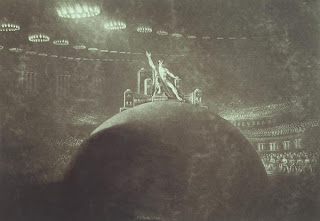
John Milton's 15th Century epic Paradise Lost speaks from Lucifer's point of view for a fair stretch of the tale. Satan is presented as a tragic hero, though still antagonistic. If that sounds really risky for an author to do, well it is. Satan's part of the story is about his unsuccessful rebellion in Heaven and sub sequent rallying of the Dark Angels in Pandaemonium. Lucifer leads his men from the front lines and rallies them with his power over the spoken word just as well as epic protagonists like Odysseus. If Milton's verses on the "behind the scenes" of God's will parallel with Dante's, then this portrayal of Satan polarizes them equally. It has also raised quite a stir among scholars, as they debate the meaning behind Milton's words. 20
 |
| Looney Tunes, "Devil's Feud Cake" |
 |
| South Park |
We often see Satan as a malicious force of temptation and evil, with red skin, horns, a goatee, and impeccable skills on the fiddle. Despite Dante's rather ingenious way of showing how internally weak the Devil is, he's always coniving in popular culture.
John Milton's 15th Century epic Paradise Lost speaks from Lucifer's point of view for a fair stretch of the tale. Satan is presented as a tragic hero, though still antagonistic. If that sounds really risky for an author to do, well it is. Satan's part of the story is about his unsuccessful rebellion in Heaven and sub sequent rallying of the Dark Angels in Pandaemonium. Lucifer leads his men from the front lines and rallies them with his power over the spoken word just as well as epic protagonists like Odysseus. If Milton's verses on the "behind the scenes" of God's will parallel with Dante's, then this portrayal of Satan polarizes them equally. It has also raised quite a stir among scholars, as they debate the meaning behind Milton's words. 20

Satan in Paradise Lost
Tuesday, November 20, 2012
Hades vs. Satan
Long before Lucifer took up his fiddle, a god named Hades presided over a similar kingdom of death. But not as similar as some believe. Even the nigh-infallible Dante drew somewhat unfair parallels between the orignal Dark Angel and Greece's God of Death (though this was likely due to the fact that even back then people thought the Greek myths were cool).
Part of the Greek origin myth tells of how Zeus freed his brothers and sisters from the stomach of their father Cronus, thus overthrowing the titans. Zeus and two of his brothers then divided the world into three and drew lots over sovereignty. Zeus became king of the heavens and everything under the sun. Poseidon won lordship over the seas, and the third brother, named Hades, "the unseen," by the humans, gained the Underworld. 12
The Underworld is not Hell. All dead went to the Underworld, regardless of morality. If you did wrong, there were Hellish places for you to stay, but it wasn't the norm. Regardless of this, death was still scary. Hades became a name whispered, much as we don't speak of Hell in regular conversation.
There is very little written about Hades, likely attributed to his less revered and more feared reputation. There is only one piece of evidence to suggest Hades was anymore violent or dark or evil than his kin. This would be the tale of Persephone and how Hades wooed her to be his bride with a pomegranate.
So, the bottom line is that while Satan is an evil lord of evil evilness, Hades is just doing his job. Modern culture tends to show Hades with shades of his devilish counterpart.
 |
| Satan in the Inferno |
Part of the Greek origin myth tells of how Zeus freed his brothers and sisters from the stomach of their father Cronus, thus overthrowing the titans. Zeus and two of his brothers then divided the world into three and drew lots over sovereignty. Zeus became king of the heavens and everything under the sun. Poseidon won lordship over the seas, and the third brother, named Hades, "the unseen," by the humans, gained the Underworld. 12
 |
| And who wouldn't trust this guy? |
The Underworld is not Hell. All dead went to the Underworld, regardless of morality. If you did wrong, there were Hellish places for you to stay, but it wasn't the norm. Regardless of this, death was still scary. Hades became a name whispered, much as we don't speak of Hell in regular conversation.
There is very little written about Hades, likely attributed to his less revered and more feared reputation. There is only one piece of evidence to suggest Hades was anymore violent or dark or evil than his kin. This would be the tale of Persephone and how Hades wooed her to be his bride with a pomegranate.
So, the bottom line is that while Satan is an evil lord of evil evilness, Hades is just doing his job. Modern culture tends to show Hades with shades of his devilish counterpart.
Tuesday, November 13, 2012
How to be Evil (or not) by Brian Perkins
Have you ever heard of an anti-hero or an anti-villain? I've always been somewhat confused as to what the difference was. At a glance, they seem like the same intermediate step between evil and good, but there is a difference.
So, you have a good guy. He does good things in uncompromisingly good ways. He's polite, he follows the rules, and he will never go against his beliefs to accomplish his goal. As you travel down the ladder the hero gaets a little more tarnished; he may have a tragic past, or may have questionable methods. 15 22 1
The anti-hero takes this a step further. He has good goals/intentions, but is willing to do potentially bad things to accomplish them. Alternatively, he may believe in "good," but doesn't agree with the laws, and so he takes justice into his own hands.
If an anti-hero does good things in a bad way, then an anti-villain does bad things with a strong moral fiber. His goals fit the "evil" standard, but there are things he will not do, lows he shan't sink to, in pursuing those goals. Anti-heros and anti-villains walk a fine line between good and evil.
Then you have sympathetic villains. These guys are really evil, but the reason they became evil, or their behavior, warrants your pity or remorse.
Finally, there are the completely irredeemably evil characters. They kick puppies, they twirl mustaches, and they do it with a smile on their face.
Literarily speaking, there are a number of shades of grey in between the black and white of moral struggle. The "greyer" a character is, the more rounded of a persona they may be.
So, you have a good guy. He does good things in uncompromisingly good ways. He's polite, he follows the rules, and he will never go against his beliefs to accomplish his goal. As you travel down the ladder the hero gaets a little more tarnished; he may have a tragic past, or may have questionable methods. 15 22 1
The anti-hero takes this a step further. He has good goals/intentions, but is willing to do potentially bad things to accomplish them. Alternatively, he may believe in "good," but doesn't agree with the laws, and so he takes justice into his own hands.
If an anti-hero does good things in a bad way, then an anti-villain does bad things with a strong moral fiber. His goals fit the "evil" standard, but there are things he will not do, lows he shan't sink to, in pursuing those goals. Anti-heros and anti-villains walk a fine line between good and evil.
Then you have sympathetic villains. These guys are really evil, but the reason they became evil, or their behavior, warrants your pity or remorse.
Finally, there are the completely irredeemably evil characters. They kick puppies, they twirl mustaches, and they do it with a smile on their face.
Literarily speaking, there are a number of shades of grey in between the black and white of moral struggle. The "greyer" a character is, the more rounded of a persona they may be.
Tuesday, November 6, 2012
Writing Your Inner Self
Sometimes when an author is writing a book or a movie, he will insert him/herself into the story. This can be literal, like Stan Lee or , or it can be more discreet.
Often times a character based on the author appears in the book. Even if the character doesn't outwardly seem like their real-life counterpart, they may reflect the author's inner-self. What does this mean? Maybe it's the author at a different point in his life, or maybe it's a persona adopted by the author's mind. M. Night Shyamalan frequently gives himself nigh omnipotent roles in his movies, for example. 21 18
Dante and other writers (like Stephen Colbert) take this a step further by using their own names. For example, Dante the Florentine writer wrote Commedia, starring a Florentine writer named Dante. They are essentially the same person, only the real Dante probably didn't vacation in Hell.
Often times a character based on the author appears in the book. Even if the character doesn't outwardly seem like their real-life counterpart, they may reflect the author's inner-self. What does this mean? Maybe it's the author at a different point in his life, or maybe it's a persona adopted by the author's mind. M. Night Shyamalan frequently gives himself nigh omnipotent roles in his movies, for example. 21 18
Dante and other writers (like Stephen Colbert) take this a step further by using their own names. For example, Dante the Florentine writer wrote Commedia, starring a Florentine writer named Dante. They are essentially the same person, only the real Dante probably didn't vacation in Hell.
Wednesday, October 31, 2012
The Phantom of the Opera
So, when your thinking of Halloween music, there's a lot of spooky pipe organs, right?
This is only marginally related to that topic.
First written as a novel by Gaston Leroux in 1909 France, Le Fantome de l'Opera was similar to Frankenstein in that it sold very poorly when first published. What the novel lacked in any literary signifigance though was more than made up for by its musical adaptations.
The first musical was Ken Hill's British Phantom of the Opera. During one performance Hill was aproached by Andrew Lloyd Webber to establish a Broadway version. In 1988 Webber's own version of Phantom opened.
Phantom is a macabre love story about a female actor named Christine who is bedeviled by a mysterious admirer named Erik that lives beneath the Opera House. It's not exactly a horror by any stretch, but it has dark elements that win it over many a horde of (often teenage female) fans. Michael Crawford made his name in America off of the role of Erik. 11 25 15
Today Webber's play is the longest running ticket on Broadway, by over 2500 shows, as well as the first to surpass 10,000 performances. It is considered (admittedly by its own writers' calculations) to be the single highest grossing entertainment venture ever conceived, making 5.1 billion dollars.
The connection to literature is that Phantom is a classic, at least by any theater teacher's terms, in the ranks of Shakespeare. Though Leroux's novel was a flop, its legacy will likely live forever.
This is only marginally related to that topic.
First written as a novel by Gaston Leroux in 1909 France, Le Fantome de l'Opera was similar to Frankenstein in that it sold very poorly when first published. What the novel lacked in any literary signifigance though was more than made up for by its musical adaptations.
The first musical was Ken Hill's British Phantom of the Opera. During one performance Hill was aproached by Andrew Lloyd Webber to establish a Broadway version. In 1988 Webber's own version of Phantom opened.
Phantom is a macabre love story about a female actor named Christine who is bedeviled by a mysterious admirer named Erik that lives beneath the Opera House. It's not exactly a horror by any stretch, but it has dark elements that win it over many a horde of (often teenage female) fans. Michael Crawford made his name in America off of the role of Erik. 11 25 15
Today Webber's play is the longest running ticket on Broadway, by over 2500 shows, as well as the first to surpass 10,000 performances. It is considered (admittedly by its own writers' calculations) to be the single highest grossing entertainment venture ever conceived, making 5.1 billion dollars.
The connection to literature is that Phantom is a classic, at least by any theater teacher's terms, in the ranks of Shakespeare. Though Leroux's novel was a flop, its legacy will likely live forever.
Tuesday, October 23, 2012
The Frankenpost
In 1818, Mary Shelley anonymously published Frankenstein, a horror that would one day greatly influence monster media. And seeing as next week is Halloween, I figure I could write a breif blog post about it.
18 9 14
Mary Shelley's name was not on the first edition of Frankenstein, as it was still uncommon for women to write books. Reviews were mixed, with some praising its ingenious writing style and others panning its dark and sometimes meandering plot. Still, the public instatnly latched on to it, and it still holds up today.
Many of the now commonplace elements of horror literature (mad scientists, reanimated corpses, dark and stormy nights, etc.) weren't the norm before Frankenstein. Of course, the monster himself has become a staple of the modern Halloween scene. Nowadays he looks a little different then the meat puppet Shelley envisioned, but he's there nonetheless. Next week, gentle bloggers, is actual Halloween.So I have something special planned.
Well, not particularly. It's just Halloween themed again.
18 9 14
Mary Shelley's name was not on the first edition of Frankenstein, as it was still uncommon for women to write books. Reviews were mixed, with some praising its ingenious writing style and others panning its dark and sometimes meandering plot. Still, the public instatnly latched on to it, and it still holds up today.
Many of the now commonplace elements of horror literature (mad scientists, reanimated corpses, dark and stormy nights, etc.) weren't the norm before Frankenstein. Of course, the monster himself has become a staple of the modern Halloween scene. Nowadays he looks a little different then the meat puppet Shelley envisioned, but he's there nonetheless. Next week, gentle bloggers, is actual Halloween.So I have something special planned.
Well, not particularly. It's just Halloween themed again.
Monday, October 15, 2012
Where Everybody Knows Your Name
Sinfeld prides itself with being a show about nothing, a term this blogger doesn't entirely subscribe to. But before there was Sinfeld, and by extension most other shows about nothing, there was Cheers.
Cheers was an early entry into the ensemble cast genre. Taking place in a (sort of*) real life bar in Boston, the show dealt with a number of regular patrons with unique quirks. The bar itseld served the "Jerry's apartment" role, a room with essentially one camera angle that people would randomly burst into.
Frasier (star of the spin-off of the same name) was a down-on-his-luck psychologist, Norm was the typical barfly (literally everyone knew his name), and Cliff was a mailman who loved quoting facts and figures. Cliff is also Ham the piggy bank from Toy Story, which you will never be able to unhear if you ever watch the show now.
The "nothing" draw of the show came from the principal action rarely leaving the bar. Someone would bring up a conversation, the rest would join in, rinse and repaeat. There was, of course, an overarching plot like Mr. Sinfeld's sitcom, but those were the small potatoes.
20 15 4
*The outside of the bar used in stock footage is the real Cheers bar in Boston. The inside where the action took place was filmed on a setpeice. The decor of the Cheers set was then converted into a sports-bar like setting in Boston's Quincy Market.
Cheers was an early entry into the ensemble cast genre. Taking place in a (sort of*) real life bar in Boston, the show dealt with a number of regular patrons with unique quirks. The bar itseld served the "Jerry's apartment" role, a room with essentially one camera angle that people would randomly burst into.
Frasier (star of the spin-off of the same name) was a down-on-his-luck psychologist, Norm was the typical barfly (literally everyone knew his name), and Cliff was a mailman who loved quoting facts and figures. Cliff is also Ham the piggy bank from Toy Story, which you will never be able to unhear if you ever watch the show now.
The "nothing" draw of the show came from the principal action rarely leaving the bar. Someone would bring up a conversation, the rest would join in, rinse and repaeat. There was, of course, an overarching plot like Mr. Sinfeld's sitcom, but those were the small potatoes.
20 15 4
*The outside of the bar used in stock footage is the real Cheers bar in Boston. The inside where the action took place was filmed on a setpeice. The decor of the Cheers set was then converted into a sports-bar like setting in Boston's Quincy Market.
Subscribe to:
Posts (Atom)